Mastering the 2026 ICA Passport Photo Requirements: Pro Guide
Learn how to create perfect, ICA-compliant passport photos in 2026. This technical guide covers pixel dimensions, lighting strategies, and newborn photography tips to ensure your MyICA application is accepted on the first try.
If you have ever tried to renew your Singapore passport online, you likely know the specific brand of anxiety that comes with the photo upload screen. You have taken twenty selfies against a white wall, cropped them until your eyes hurt, and yet, the MyICA portal keeps spitting back errors like "Invalid Aspect Ratio" or "Image does not meet quality requirements."
It is frustrating because the rules feel like a moving target. In 2026, the Immigration & Checkpoints Authority (ICA) has reached a level of technical scrutiny that demands biometric precision. Why? Because your photo isn't just for a human border officer anymore; it is for an AI algorithm that maps your biometric features to a fraction of a millimeter. Using a specialized passport photo app can help bridge this technical gap, ensuring your submission meets the ICA official photo requirements without the guesswork.
The 2026 Passport Context: Why ICA is Stricter Than Ever #
Singapore has always been at the forefront of border technology. As we move through 2026, the ICA has fully integrated advanced facial recognition systems at automated lanes across all checkpoints, including the New Clearance Concept (NCC). For these machines to work—allowing you to walk through Changi without even taking your passport out—the photo on your digital record must be high-fidelity and mathematically precise.
The Move to Contactless Clearance #
We have moved past the era of the physical photo booth. While those dusty curtains still exist in some MRT stations, they often produce prints that are difficult to digitize. The ICA system now prioritizes digital uploads via the MyICA e-Service. This shift means the burden of technical compliance—lighting, resolution, and aspect ratio—has moved to the applicant. If your photo isn't compatible with the algorithm, you simply don't get through the gate.
The Financial and Emotional Cost of Rejection #
A rejected photo can delay your passport issuance by weeks. For PR applicants or those renewing an Employment Pass, a photo rejection can stall legal status processes. High-fidelity photos are required because facial recognition at Singapore borders is now the standard for efficient travel.
The MyICA Technical Blueprint: Pixels, Millimeters, and Ratios #
Many users are confused by the "35mm wide by 45mm high" rule. However, when uploading digitally, you are dealing with pixels, not millimeters.
400x514 Pixels: The Digital Gold Standard #
When you use a passport size photo editor, the goal is to reach the exact dimension: 400 pixels wide by 514 pixels high. This creates an aspect ratio of 1:1.285. Standard smartphone photos (3:4 or 9:16) will trigger errors if not cropped precisely. This precision follows the ISO/IEC 19794-5 standards for biometric data quality.
The JPEG Compression Trap #
Aim for a file size between 150KB and 500KB. Too small, and you lose biometric landmarks; too large, and the portal's internal compressor may create artifacts. A professional passport photo maker ensures the balance between file size and image clarity.
Lighting & Environment: Setting Up Your Home Studio #
Bad lighting is the leading cause of photo rejections. The ICA algorithm requires a clear silhouette without shadows behind the ears or under the chin.
The North-Facing Window Strategy #
Avoid ceiling lights which create harsh downward shadows. Instead, stand about one meter away from a window with indirect sunlight. This provides even illumination across the face, satisfying the biometric scanner's need for balanced exposure.
The 1-Meter Rule for Backgrounds #
To ensure a "plain white" background, stand at least one meter away from the wall. This prevents your head from casting a shadow, which is a common reason for manual rejection by ICA officers.
Attire and Appearance: Dressing for the Algorithm #
Your clothing must provide high contrast against the white background. This is crucial for the AI to detect your shoulder line and head shape.
- The No-White Rule: Avoid white or light-colored shirts. Wear black, navy, or dark green to prevent "edge bleeding."
- Hair and Glasses: Hair must not obscure eyebrows. While you can wear glasses, it is recommended to remove them to avoid "specular reflection" (glare) which can block biometric data.
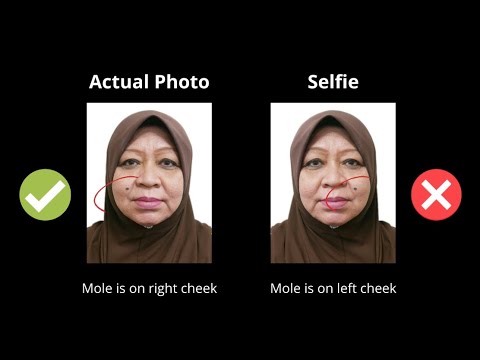
- Cultural Headgear: Dark-colored headgear is permitted for religious reasons but must not obscure facial features from the chin to the forehead.
The Newborn Challenge: A Guide for Parents #
Taking a newborn passport photo is notoriously difficult as infants cannot follow instructions.
The Floor Method #
Lay a plain white sheet on the floor and place the baby on top. Stand directly above to capture the shot. This is safer than trying to hold the baby, which often results in hands appearing in the frame—an instant rejection.
Timing and Expression #
Wait for the "quiet alert" phase after feeding. The baby must have eyes open and a neutral expression. Even for infants, the ICA prefers a closed mouth, though they offer slight leniency for very young babies compared to adults.
Pre-Flight Checklist: Your 10-Point Audit #
Before you hit upload, verify these technical details:
- Background: Pure white and free of shadows.
- Expression: Eyes open, mouth closed, neutral face.
- Eyes: Looking directly at the camera lens.
- Head Position: Level and centered; no tilting.
- Attire: Dark-colored clothing for contrast.
- Dimensions: Exactly 400x514 pixels.
- File Format: .jpg or .jpeg only.
- Recency: Taken within the last 3 months.
- Sharpness: No motion blur or digital noise.
- Head Size: Crown to chin should occupy 70-80% of the vertical frame.
Frequently Asked Questions #
How can I make passport size photo online free? #
While you can use basic tools to make passport size photo online free, they often lack the biometric validation needed for MyICA. Using a dedicated passport photo app ensures your photo meets specific head-to-frame ratios.
What is the Singapore passport photo size in cm? #
The physical size is 3.5cm wide by 4.5cm high. However, for online applications, you must use the digital equivalent of 400x514 pixels.
Why does MyICA say "Invalid Aspect Ratio"? #
This happens when your photo's width and height don't match the 1:1.285 ratio. A standard photo is too wide; it must be cropped vertically to fit the ICA's digital window.
The AI Advantage: Why IC Photo Singapore is the Safer Choice #
Manual cropping is often guesswork. If your head is too small or too large in the frame, the application will be flagged. AI-powered tools like IC Photo Singapore simulate the ICA's own validation software. Our engine measures the exact distance between your pupils and the top of the frame, providing a lifetime remake guarantee. Whether you are taking newborn photos or adult renewals, our AI ensures you get it right the first time.
Final Word: Your Path to a 5-Minute Approval #
Renewing your passport shouldn't be a source of stress. By following these technical guidelines—focusing on contrast, lighting, and pixel-perfect dimensions—you can ensure a smooth application process. If you want to eliminate the risk of rejection, use an ICA-compliant passport photo tool designed for the 2026 standards. Get back to planning your travels and leave the technicalities to the experts.
Ready to Create Your Photo?
Get your perfect passport, IC, or visa photo in minutes. AI-powered, ICA-compliant, instant download.
Create Your Photo Now